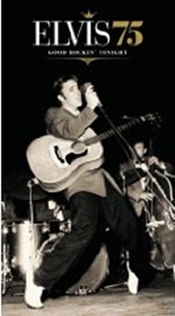

RIYL: 1950s rockabilly, 1960s pop, 1970s country, rock history in general
 In honor of Elvis’ 75th birthday – we won’t get into whether he is “the late Elvis” or still rockin’ in the wilds of Michigan – Legacy’s issuing a bunch of records, this one being first up and coinciding with a Graceland bash. In a word, it’s great stuff, a career-spanning retrospective that covers the gamut of the good, bad and ugly from rock’s first real icon, its undisputed King. Elvis diehards probably have most of the 100 tracks spanning the almost 25 years of his recorded career, from the 1953 “My Happiness” demo to Moody Blue tracks; probably only the most manic completists among longtime fans will nibble at this.
For the rest of us, however, it puts Presley’s work in context: There’s no denying the power of Young Elvis, who had an incredible combination of talent, charisma, and the stones to fuse music from black R&B records, gospel, redneck bluegrass, and loud guitars. When he walked into the Memphis Sun Studios and hooked up with label impresario Sam Phillips in 1954 to put down his brilliant first sides, he was just a singer who loved all the music he heard from both sides of the tracks and just didn’t particularly care what people would think if he did. Maybe I’m alone in this opinion, but I believe that all the stuff that came after – the politics, the goofy Graceland stuff, the Army, the movies, the drugs, the Comeback, stuffing his sweaty and overweight frame into sequined Vegas costumes, and finally, the overdose, were not of his doing but caused by external forces he endured, albeit willingly at times. The early songs still sound fresh and crisp: “Mystery Train,” “Blue Moon of Kentucky,” “Jailhouse Rock.” A powderkeg of testosterone and unbridled joy. Rock, undistilled. Then comes the ballads, the country, the gospel stuff…the brutal “Suspicion.” It’s all here, along with the 2002 techno remix of “A Little Less Conversation.”
Listening to this end to end, it’s bizarre to hear Elvis’ transformation from the white-hot beginning to the dying embers of a career when he finally ingested that deadly cocktail of prescription drugs. At first, he synthesized all these at-the-time disparate musical influences to create such musical magic. By the mid-1970s, however, he was clinging desperately to country, sounding like a second-rate Hank Jr. knockoff at best (who himself was a poor Xerox of his daddy). Elvis ended up the ghost of his 1950s and early-’60s heyday, barely recognizable and subject to all the ridicule that’s followed his 1977 death. The moral of the story? Elvis wasn’t larger than life; he was just another rock star, human after all. But just like the NFL has good quarterbacks and bad, as far as rock stars go, Elvis was no Kyle Orton; he was Brett Favre, the greatest statistical player – unstoppable at first but maybe should have called it quits before his career turned into a circus. If you’ve never dug Elvis seriously, check out this box. There’s a lot more going on here than Jay Leno punch lines. When he was on top of his game, he wrote rock history with a gorgeously powerful voice and a beguiling smile. This box remembers that part, best. (Sony/Legacy, 2009).


 If you are sick of the state of the music business, if you need some new music that sounds truly new, if FM radio bores you to tears and even the blog-rock CDs showing up on every music site’s “best of” list lets you down because it all sounds like half-practiced, overproduced slacker junk played by snotty people you wouldn’t invite to parties at your place…please go and buy this box set. The culmination of the two-year Radiolarians project, The Evolutionary Set is the career pinnacle of MMW, jazz-rocking experimentalists who are neither jazz nor rock, but “avant-groove.” Kind of an thinking-fan’s instrumental Phish, this trio started with an idea in 2007: Write some proto-jams, briefly rehearse them, take them on tour, develop them live, and then record the finished project. It spawned three ridiculously tight, sometimes funky, sometimes rockin’, sometimes ambient-noodling numbers that sound like nothing you’ve heard. It doesn’t hurt that these guys not only have played together almost two decades, but that they’re exceptional players. The box set includes the three Radiolarians albums, a double-vinyl set, a DVD documentary, a remixes disc, and a live album. It’s intelligent jazz, it’s primitive rock. It’s funky stuff. It’s an updated 2009 version of the strangely beautiful Miles Davis period that included the records On The Corner and A Tribute to Jack Johnson. It’s everything indie music’s all about, and while the major labels and commercial radio won’t touch this stuff, you should. (Indirecto Records, 2009)