Category: Pop (Page 71 of 216)

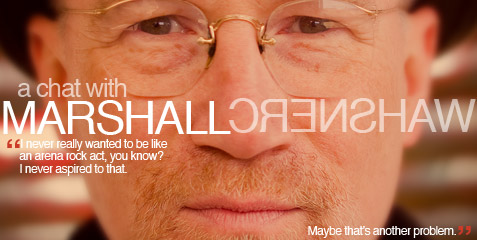
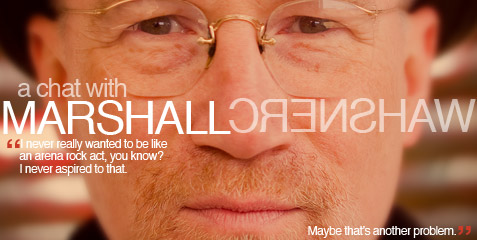
Marshall Crenshaw talks about Jerry Boys, working for Disney, and his love for the lost art of making records

Talking with Marshall Crenshaw is like being invited to the rock ‘n roll grown-up table. After minding your manners at the kid’s table for years, you finally get the chance to show your elders how much you’ve learned about music…only to realize just how little you know. The man is an encyclopedia of rock, which makes sense when you consider that he played John Lennon on the stage, Buddy Holly in the movies, and wrote the instructions for fictional rocker Dewey Cox on how to walk hard. On the eve of a series of shows on both sides of the pond in support of his new album Jaggedland, Crenshaw spoke with Bullz-Eye about how he never wanted to be an arena guy, and offers his two cents on some of the cover versions of his songs. He also explained why he inadvertently terrified his interviewer at a concert six years ago, but that story is off the record.

BE: I would just like to state that there should be a law that forbids you from taking six years between albums.

MC: I know, it’s funny, isn’t it? But that’s how long it took, I guess. My friend Don Dixon said everybody should do a record every four years, and no sooner than that. I don’t know where he got that from, but I guess that’s just what his body clock tells him. Anyway, yeah, I know, six years is a long time. But it was worth it, you know? It was worth taking the extra time and the extra care, I think.

BE: I read that it was Jerry Boys’ work on the Ry Cooder album that attracted you, but I’m sure it didn’t hurt that he also recorded the Beatles.

MC: You know what? I found that out fast, because I have that book, there is a book called “The Beatles Recording Sessions.” When it came out I just read it and read it and read it, like it was the Bible. So I had seen his name in there but I didn’t make the connection when I bought Mambo Sinuendo, and just proceeded to fall in love with it. Then I went on to his website and I went, “Oh yeah, right.” But that’s only just the beginning of the story with him. I mean, God, you’ve got to really give it up for guys who are…you know, just have that deep of a well of experience and have done that much really high-quality work.

BE: Did you ever have designs of making an Imperial Bedroom-type record with a Geoff Emerick or an Alan Parsons?

MC: No, none of those guys ever crossed my mind. I mean, with all due respect, and so on and so forth. And again, the record that really made me think of Jerry Boys is a record where everybody just sat in the room and played at the same time, you know, Mambo Sinuendo. There are some tracks that are really heavily crafted and edited and stuff like that, but mostly it’s just guys in a room, and the sound of the room. That was what I dug about that record.

BE: Have you ever reached a point where you thought to yourself, “Screw the solo career, I’m going to write songs for Disney artists,” or “I’m going to write songs for up and coming country singers”?

MC: Yeah, I have. Sure, of course. I mean, I have even done the first one. I did a project for Disney Television Animation. I worked on it for about half a year, wrote about a half-dozen songs for an animated sequel to “101 Dalmatians.” It’s been sort of an oddball, patchwork sort of a résumé with me, really. The main thing is my records and my songs, that’s really what it’s about. But I’ve taken lots of side trips. I was in “La Bamba.” One of my songs right now, “You’re My Favorite Waste of Time,” is in a breakfast cereal commercial in Europe.

BE: That makes sense, since it was a big hit for Owen Paul in the UK.

MC: Yeah, you know about that.

BE: Yes. And I just recently heard Bette Midler’s cover of the song, which I can’t say I share the same enthusiasm for.

MC: I was delighted when she recorded it…anyway, what was I saying? Oh, the Nashville thing. Yeah, I had a publisher and a good friend who used to constantly encourage me to go to Nashville. And I did try it, I went there and dabbled in it a little bit, I just could never get that motivated, you know? For better or for worse, the thing I really love is record-making. I just think it’s a great art form. When it comes to the idea of making a record and creating a body of songs for a record, that’s when I really get motivated, you know? But the Nashville thing just sort of never felt like the right direction for me.

To read the rest of Bullz-Eye’s interview with Marshall Crenshaw, click here.

Rick Rubin: In the Studio

For those looking forward to a detailed analysis of one of music’s all-time greatest producers, “Rick Rubin: In the Studio” is a colossal letdown. Based on the number of paragraphs that feature lines like “as he told Australian Guitar,” “Rubin told the LA Times,” “Rubin said to Mix,” and so on, one wonders if author Jake Brown spoke to a single person associated with Rubin when assembling his book, or if he put it together using Wikipedia. To make matters worse, four or five pages will go by without even a mention of the man, instead focusing on how the Red Hot Chili Peppers like to jam and what gear they use in the studio. It’s not a laborious read – barring the first chapter, which is a nightmare – but it’s also not nearly as interesting as one would hope. Pity. (ECW Press 2009)

Datarock: Red

Our first impression of Red, the new album by Norwegian electro rockers Datarock, was that we just found the next Soulwax, swiping the guitar line from “Sweet Child o’ Mine” and the vocal intro to Prince’s “Let’s Go Crazy” for a galloping, dialogue-driven song “The Blog.” What follows is more in line with LCD Soundsystem which, blogosphere fanatics be damned, is not a good thing. Jumpy drum tracks, cascading synth lines, fey vocals, angular guitar fills…you’ve heard everything here before, by two different generations of bands. “True Stories” is one giant Talking Heads slurpfest, from the lyrics – which are nothing but Talking Heads song titles – to the music, which sounds like the Heads crossed with their spinoff band the Tom Tom Club. “Molly,” God love ’em, is a love letter to Molly Ringwald. (“Sixteen Candles! The Breakfast Club!”) There are some strong musical ideas here; the instrumental “In the Red” is a keeper, and the down-tempo album closer “New Days Dawn” suggests that the band’s true strengths are more in line with the Pernice Brothers and Richard Hawley than with Shiny Toy Guns. The lyrics, however, are so desperate for attention – look at us, we’re talking about the ’80s! – that the urge to dance is quickly repressed by the urge to punch something. Ditch the data, guys, and set yourselves free.
(Nettwerk 2009)

Sarah Bettens: Never Say Goodbye

Formerly the voice of the internationally successful band K’s Choice, Belgian-born Sarah Bettens has made only modest progress in her efforts to garner wider solo recognition on this side of the Atlantic. Her last effort, Shine, showed she had the potential; with songs that veered from quiet contemplation to full-throttle rockers – aided and abetted by a bittersweet vocal informed by wistful reflection – Shine’s songs appeared immediately engaging. Think Carole King’s effusive optimism tempered by the guarded desire of Jewel and Fiona Apple.

This time around, Bettens takes a more sinewy route, adapting an approach that finds her keeping company with classic torch singers like Nina Simone, Ella Fitzgerald and other divas of a barroom variety. Bettens recorded several of these songs before a live audience, and judging by an audible audience response, she was well received. She ups the familiarity factor by covering a pair of standards – “Cry Me a River” and “I Can’t Make You Love Me” – but even her originals strike an immediate connection courtesy of her sultry, seductive vocals and unobtrusive piano-based arrangements. In fact, Bettens’ voice oozes emotion and the quiet nocturnal settings suggest that the introspection suits her well. Never Say Goodbye may not represent the grand hello she needs to increase her following, but it does affirm the fact she’s clearly arrived.

Sarah Bettens MySpace page

A.A. Bondy: When the Devil’s Loose

A.A. Bondy’s penchant for creating melodious tomes belies his aggressive origins as point man in the hardcore Southern grunge outfit Verbena. While the group racked up numerous Nirvana comparisons – and even enticed Dave Grohl to produce their major label debut – it was fortuitous that the band eventually opted to go their separate ways. That allowed Bondy time and motivation to regroup and, in fact, refocus his direction. His first solo outing, American Hearts, turned some heads, but When the Devil’s Loose will likely be the one to draw the most attention, thanks to a cache of hollow-eyed balladry, supple melodies and a sublime sense of songcraft. The album gets off to a slow start – mellow, laconic, sad and subdued — but as it progresses, the pace picks up, and with it, the hooks become better defined. “On the Moon” betrays a hint of antebellum ambiance, almost as if it came from the pen of Stephen Foster. “I Can See the Pines Are Dancing” and “The Mercy Wheel” are quietly compelling, an underlying determination punctuating the restive posture. Admittedly, When the Devil’s Loose takes further listens to fully appreciate its subtlety and nuance, but any time invested ultimately becomes time well spent. (Fat Possum 2009)

A.A. Bondy MySpace page

« Older posts Newer posts »