Page 19 of 583

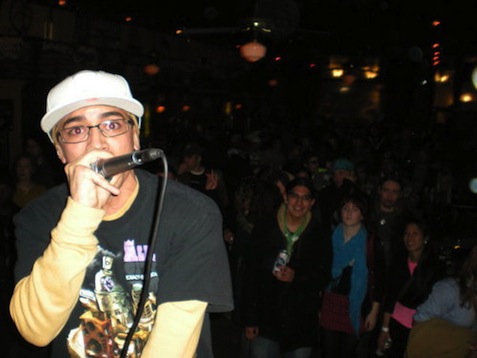
Underground Rapper of the Week: Big Zach (New MC)

Underground Rapper of the Week is a new feature designed to raise awareness of rappers from all over the world who, if that world were a perfect place, would be more famous than they are. It will be updated every Tuesday before the sun goes down. Feel free to email suggestions of slept-on rappers from your city or wherever to: ezra.stead@gmail.com

Among the pioneers and still active pillars of the Twin Cities Hip-Hop scene, one that often goes unsung is Big Zach (aka New MC) of the beloved underground crew Kanser. Though not as well-known nationally as Atmosphere, Brother Ali, Doomtree or the late, great Eyedea, Kanser is nonetheless one of the most historically important and influential groups in Minnesota, and Zach is likely second only to Eyedea as the most successful battle rapper in the state’s history. Now retired from the battle scene, Zach continues to make beautiful, thoughtful music with Kanser and his more organic “hippie-hop” group More Than Lights, as well as on his own as a solo artist.

Kanser first formed all the way back in the mid-90s, when Zach was still in high school, and though the crew began with a shifting cast of several other members, only Zach and Haitian-American rapper Unicus have remained constant from then until now. While many two emcee crews, from Outkast to Wide Eyes, function because of how closely they resemble each other vocally, Zach and Unicus complement each other’s voices in precisely the opposite way. Though they couldn’t sound much more different from one another, these is exactly what works so well about their sound, with each emcee offering his own unique perspective and experience. One of the best examples of this smooth interplay is the live favorite “Legacy” from their stellar 2008 album Future Retro Legacy, which may be their best work together.

Zach’s old side project from before More Than Lights, Traditional Methods, is also some of his best work, and having a live band behind him gives his lyrical delivery an even more organic feel. The group’s one album, Falling Forward, reflects a more political side of Zach’s lyricism, complemented by fellow emcees Sarah White and Big Shiz and backed by members of the live Hip-Hop group Heiruspecs on bass and guitar. However, Zach’s first solo album, White Jesus, remains his very best work to date. A smooth, relatable record that alternates between funny and tragic and never seems less than heartfelt, White Jesus gives the listener that rare feeling of really getting to know an artist’s life. On “Reality Rap,” Zach shows his incredible skill as a storyteller as he documents the worst year of his life: “In ’03, my summer never set in / My brother went to prison and Denny, he went to heaven.” “Sub Shop,” produced by Atmosphere’s Ant, shows a lighter side of Zach’s storytelling abilities, as he tells humorous tales of working as “the fastest sandwich maker in the world,” while “Meet the Parents” tells a slightly sweeter (but still funny) story of a past girlfriend whose parents “voted for Bush, they think Jesus was white / Probably won’t relate to his life.”

Of all the great songs on this album (and they’re all great songs), the one line that stands out the most for me is from the final song, “Emo Rap,” when he says, “Life is always up and down steadily / I just romanticize the memories.” A lot of these romanticized memories made their way into his book, Headspin, Headshots & History: Growing Up in Twin Cities Hip Hop, published late last year. A thorough, authentic document of the rise of a vital cultural movement, mixed with a strikingly honest and engaging memoir of Zach’s own life as part of that movement, this book is essential reading for Hip-Hop heads in the Twin Cities and beyond. More Than Lights releases a new album on October 5th, with a release party weekend on the 5th and 6th, so keep an eye out for Big Zach and his friends as they continue to deliver positive punchlines.

Underground Rapper of the Week: K’naan

Underground Rapper of the Week is a new feature designed to raise awareness of rappers from all over the world who, if that world were a perfect place, would be more famous than they are. It will be updated every Tuesday before the sun goes down. Feel free to email suggestions of slept-on rappers from your city or wherever to: ezra.stead@gmail.com

K’naan is much more successful and well-known than most of the underground rappers profiled in this column, but still, in this writer’s opinion, not nearly successful and well-known enough. Based on the definition of “underground” stated above, therefore, K’naan definitely fits the bill. In a perfect world, this guy would be Top 40, while cats like Waka Flocka Flame would be completely unknown.

Born in Somalia, K’naan spent his pre-teen years surviving the Somali Civil War and other hardships in Mogadishu, one of the most dangerous and violent places on earth. When he was 13, his family fled the war-torn region and joined relatives in New York City, before moving to Canada, where K’naan learned English, partly by listening to Hip-Hop records. His birth name, Keinan, means “traveler” in the Somali language, and his life and music reflect that. His breakthrough album, 2005’s The Dusty Foot Philosopher, is a beautiful mix of varied influences, as well as K’naan’s own original style and voice. The album blends world music rhythms with hardcore, conscious Hip-Hop for a sound that works equally well in the dance club or in the headphones, whether you want to move your ass to it or carefully dissect its sharp, thoughtful lyricism.

Tracks like “Soobax” and “In the Beginning” showcase this versatility, with a rhythm that makes it almost impossible not to move coupled with lyrics that make you think, while other songs like “What’s Hardcore?” and the album’s title track bring that raw, conscious Hip-Hop lyricism right to your front door. On “What’s Hardcore?” he sums up his experience growing up in Mogadishu with lines like “Life is cheap here, but wisdom is free,” and “If I rhymed about home and got descriptive / I’d make 50 Cent look like Limp Bizkit.” Despite avoiding gangsta rap cliches in favor of empirical realism, K’naan is not above some good old-fashioned battle rhymes, as evidenced on “The Dusty Foot Philosopher,” where he spits lines like “My mind is like your life, straight up, ’cause it’s made up” and “I’m not gonna sit here and whine like crushed grapes / My mind leaves you speechless like duct tape.”

K’naan’s follow-up album, 2009’s Troubadour, helped to bring his music to a wider audience with guest spots from high-profile artists like Adam Levine of Maroon 5, Kirk Hammett of Metallica, Mos Def and Chali 2Na, as well as the legendary Chubb Rock on “ABCs,” one of the album’s best songs. This album has a more polished, mainstream-friendly sound without sacrificing the traditional rhythms and conscious, philosophical lyricism that made K’naan great on his earlier works. With his latest EP, More Beautiful Than Silence, featuring guest spots from Nas and Nelly Furtado, K’naan continues to blow up, and few rappers alive deserve it more than he does. If you’ve been sleeping on K’naan, take a minute to listen to this immensely talented and hard-working artist.

Underground Rapper of the Week: Spy MC

Underground Rapper of the Week is a new feature designed to raise awareness of rappers from all over the world who, if that world were a perfect place, would be more famous than they are. It will be updated every Tuesday before the sun goes down. Feel free to email suggestions of slept-on rappers from your city or wherever to: ezra.stead@gmail.com

I can personally attest that Spy MC is one of the hardest working underground rappers in the game right now. A San Antonio, Texas, native who started rapping at the age of twelve and came up as a drum & bass MC in the Texas rave scene of the early 21st century, Spy moved to the Twin Cities of Minnesota in 2006. Along with his deejay brother and two producers also hailing from San Antonio. Together they formed the group SF Wrecks, which then morphed into the huge super-group Death Ray Scientific (DRS), with members of Wide Eyes, Matching Wits, Dialogue Elevaters and other underground Minneapolis rappers, deejays and producers.

Along with his own formidable work on the mic, Spy has always been a tireless promoter of not only himself (as most rappers are), but also of other artists he considers worthy. He has proven this time and time again in various ways, such as the open mic series “Switch,” run by DRS at Minneapolis’ legendary Dinkytowner Cafe. Largely organized by Spy, Switch gave many up-and-coming Twin Cities artists their first real sets, opening for more established headlining acts like Kanser, Carnage and even the late, great Eyedea and his group Face Candy. Spy continues to help build the Twin Cities’ underground Hip-Hop community through its otherwise largely stagnant battle rap scene. Having brought GrindTimeNow to Minnesota in June of 2009, he is now the Promotional Coordinator and co-host of The Loud Mouth League, which keeps GrindTimeNow’s tradition of a capella battle rapping alive.

With so much organization and promotion on his plate, it’s amazing that Spy manages to put out his own music, let alone music as dope as the work he has done with fellow DRS alumni Sean Anonymous and Shelltoe as Bottom Feeders, and his upcoming solo EP, Unfinished Business. Produced by MoonDoctoR and debuting online by the end of the summer, Unfinished Business is the kind of self-assured but still hungry solo debut you would expect from someone who got in the game at the age of twelve and hasn’t slowed down since. As he says on the Juice-featuring grind anthem, “Twenty Four Seven,” Spy is “planning domination / Verbally, locally, most certainly globally / Heard of me? Know me? Show-murdering dope emcee.” Bottom Feeders homie Sean Anonymous and Chicago’s Phillip Morris also pop up on “Room and Space,” which finds Sean and Spy seemingly competing for the fastest, freshest flow on the second and third verses. I’ll leave it to you to decide who wins that one, but rest assured that Spy MC does what he does, and likely always will.

Underground Rapper of the Week: X:144

Underground Rapper of the Week is a new feature designed to raise awareness of rappers from all over the world who, if that world were a perfect place, would be more famous than they are. It will be updated every Tuesday before the sun goes down. Feel free to email suggestions of slept-on rappers from your city or wherever to: ezra.stead@gmail.com

As I’ve said before, Orlando (also known as Ozone), Florida, is one of the most exciting Hip-Hop scenes in America today, and X:144 is one of its forefathers. A modern-day renaissance man whose skills encompass emceeing, beat production, mixing, mastering and now even film and music video directing, X:144 has a vital, energetic sound that practically commands the listener to move. Along with his deejay, SPS, he is one of the most futuristic and forward-thinking artists working today, while still capturing the old school feel of ’70s soul and golden age ’90s Hip-Hop.

As a producer and recording engineer, X:144 has worked with some of the best of the past and present, including Kool G Rap, MF Doom, Saigon, Joell Ortiz, and his Orlando homies Solillaquists of Sound, and he is currently at work on an undisclosed project with Lauryn Hill. He is also the champion of several beat producer battles, including the first ever Scribble Jam Producer Battle in 2007. As a lyricist and emcee, he leans toward the socially and politically conscious style favored by Solilla, but with his own unique sound and delivery. His carefully enunciated but pleasantly drawled flow gives the impression of a man who is both smarter and harder than you, but with the self-confidence not to feel the need to flex either.

The debut album from X:144 & SPS, M.E., begins with a brief and profoundly silly goofing-around-in-the-studio intro track before launching into “The Call Out,” a banging, fast-paced track that showcases the versatility and intelligence of both artists. As the title suggests, it is something of a manifesto song that explores X:144’s many social concerns, as when he raps “Nigga, nigga, nigga, Mister Cracker / Stop actin’ like we got those differences, it don’t matter.” Many of his songs find him in this mode, but he is at least equally concerned with self-exploration, preferring to point fingers within rather than outward. As he says on “3 Degrees of Ventilation,” he is “very comfortable in my suit / Not wearin’ this shit because it looks cute,” and he is equally comfortable with all sorts of subject matter, as he proves on the wonderfully funky and insightful love songs “If the Shoe Fits …” and “Almost.”

The M.E. album’s closing tracks, “From Self” and “P.O.M.,” find X:144 stating his purpose to continue moving forward and evolving, as he clearly hopes all of humanity will. For his part, he has certainly continued to grow as an artist, branching out into the field of filmmaking by directing excellent, highly cinematic videos for two songs from Solilla’s No More Heroes album, “Gotham City Chase Scene” and “Marvel.” Since then he has also made a very funny and thoughtful short film, “That’s Kinda Gay,” which nicely skewers the absurdity of homophobic rhetoric, and a more serious short documentary, “Export to Egypt,” about his experience of the recent Egyptian revolution. He is currently at work on his first solo album, but until that’s finished, enjoy some more fiya from X:144 and fellow Ozone rapper Synopse.

How to Customize a Guitar for Your Needs


Free image courtesy of FreeDigitalPhotos.net

When a person is fist learning to play the guitar they are usually content to use the instrument as it was originally manufactured. Eventually, however, the desire to customize the guitar to suit one’s musical and personal styles occurs. The musician with an unlimited budget can take their guitar to a professional shop and have it revamped. However there are several modifications that can be done by the owner:

The String’s the Thing

The easiest way to customize is to change out the strings. Because strings are made of several different materials and come in a variety of gauges, the tone of a guitar can be altered with different types. Classical guitars, which used to use catgut, now typically have nylon strings. Acoustic guitar strings are made of bronze or brass with different base metals. The type of metal influences the sound. Electric guitar strings must contain at least some steel due to the need for magnetism in generating sound.

The gauge of the strings influences the ease of playing and the tonality of the instrument. Lighter gauge strings are a good choice for jazz musicians. They are also an excellent choice for beginners, since they are easier to play. Electric guitar strings can also have different types of wrappings that influence their tone.

Pickup and Party

Another way to change up and add power to the guitar’s sound is to change out the pickups. Depending on brand of guitar and the type of pickup, a fuller brighter sound can be obtained. Adding a pickup can amplify the sound and add clear tones that aren’t harsh. Adding chrome pickups creates the tight tones that perfectly compliment rock or rockabilly music.

There are manufacturers who specialize in replicating the sound of vintage guitars to recreate the roots sounds of the early days of modern rock and blues.

Scalloped Frets

A more radical way to alter the guitar is to scallop the neck. Scalloping removes the wood between the frets so that a light touch is all that’s needed to create a big sound. A scalloped neck also allows easy bending for the blues and metal rock player.

Scalloping the neck can be time consuming and requires some tools. It’s important to take care not to damage the frets when filing out the wood between them. This can be done by hand with a round file. There is a great deal of sanding and buffing involved to create a smooth trough between the frets. Power tools simplify the various steps in the process.

Changing out the head or the whole neck can alter both the appearance and sound of the instrument. There are other cosmetic modifications that can be done to personalize the guitar’s look. Cosmetic changes like adding a new pick guard, painting or adding decals will change the look without changing the sound. Although many changes are easily done at home, for more complex alterations, local guitar teachers or music store personnel can provide references.

« Older posts Newer posts »