Category: News (Page 29 of 136)

Ticketmaster and Live Nation announce merger

The merger is valued at $2.5 billion and the surviving company will be called Live Nation Entertainment.

The deal is subject to the usual legal issues, including regulatory review, and there’s sure to be some pressure against it from the music industry and others who see this consolidation as a threat.

—Management: A lot of ego to fit into one space … Barry Diller, chairman of Ticketmaster Entertainment, will be chairman of the board with Michael Rapino, now CEO of Live Nation, as CEO and president, and Irving Azoff, now CEO of Ticketmaster, as executive chairman and CEO of Front Line.

—The name change: Dropping the Ticketmaster brand in favor of Live Nation could be the first step toward distancing the new company from the negative press surrounding the long-standing ticketing giant. A WSJ source said management wants to diminish the impression that the “company is out to gouge” consumers—as concert-goers have long complained about the service fees Ticketmaster tacks on to ticket prices.

It will be interesting to see if this passes the anti-trust test. I suspect they will have some trouble, but who knows.

The news is coming at a time when Ticketmaster is struggling with some bad press following the Springsteen ticket fiasco.

Bruce Springsteen has responded to his fans’ outcry following Ticketmaster’s problem-laden sale of his Working on a Dream tour tickets earlier this week. Countless fans reported technical malfunctions during the onsale, while others complained that Ticketmaster forwarded them to the company’s secondary ticket site, TicketsNow, even though seats were still available through Ticketmaster. The New Jersey Attorney General has also announced an investigation into the sale. Ticketmaster has since issued an apology to Springsteen, and vowed to make amends to confused fans.

“Last Monday, we were informed that Ticketmaster was redirecting your log-in requests for tickets at face value, to their secondary site TicketsNow, which specializes in up-selling tickets at above face value. They did this even when other seats remained available at face value. We condemn this practice,” Springsteen and his tour team said in a letter posted on Bruce’s official site. “We have asked this redirection from Ticketmaster to TicketsNow cease and desist immediately and Ticketmaster has agreed to do so in the future and has removed its unwanted material from their and our site.”

As for the merger, Bruce wasn’t very supportive of that idea.

Springsteen isn’t keen on the idea of a Live Nation Ticketmaster merge either. “A final point for now: the one thing that would make the current ticket situation even worse for the fan than it is now would be Ticketmaster and Live Nation coming up with a single system, thereby returning us to a near monopoly situation in music ticketing,” Springsteen writes. “If you, like us, oppose that idea, you should make it known to your representatives.”
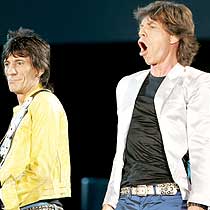
Rolling Stones to tour in 2009?

Q104.3 says yes, if Ronnie Wood has his way.

The Rolling Stones are reportedly putting plans in place for a 2009 tour – after guitarist Ronnie Wood’s hopes of reuniting The Faces fell through.

Wood was eager to get the seventies band back together, telling Rolling Stone magazine that he and former frontman Rod Stewart were working on new material and talking about a series of concert dates later this year.

But Stewart dismissed the comeback reports, with his representative saying, “There are no plans for a Faces reunion tour this year.”

However, it is alleged Wood is eyeing a Rolling Stones tour because he is desperate to earn more cash to cover his impending divorce from estranged wife Jo.

The insider adds, “Keith (Richards) is particularly close to Ronnie and told him it would be a great way of getting back on his feet, both personally and financially, after all that’s happened over the past several months.”

Wood left his wife of 23-years in 2008 after his affair with 20-year-old Ekaterina Ivanova was exposed. He subsequently moved out of the family home and has offered Jo a reported $4.9 million-a-year divorce deal.

If you can, forget for a moment the picture of Wood, 61, having an affair with a 20-year-old. I mean, he literally could be her grandfather. Ew. But what if this affair ultimately resulted in the Stones going on tour so that he could generate some cash to pay for his divorce?

That’s some expensive nookie.

Rolling Stone breaks down the odds for Super Bowl XLIV halftime act

It’s almost a year away, but that didn’t stop the folks at Rolling Stone from throwing out the names of a few potential acts to follow in Bruce Springsteen’s footsteps.

It’s a tall order to fill: applicants must be legendary but still active, rocking but not raucous, and as big as the game itself. So who’s left? Oddsmakers are already lining up favorites for next year’s Lombardi Trophy (The Patriots? Really? No love for your new champs, the Pittsburgh Steelers? Your loss, Vegas.), so we thought we’d set the odds for next year’s halftime show. The NFL could go country (Tim McGraw? Taylor Swift?) or pop (Kelly Clarkson will soon return to us), but you have to presume they’ll stick with what works — big rock from big names. We have, of course, completely pulled these names and numbers out of thin air, plus gambling’s illegal just about everywhere, so keep your money in your wallet.

The Who
Pros: Legendary band with a sound louder than the game itself.
Cons: None. They’re the Who.
Odds: 3/2

In addition to the magazine’s suggestions — The Who (solid), Bon Jovi (solid), AC/DC (too hard), John Mellencamp (solid), Metallica (too hard), Van Halen (maybe), Nickelback (why?), Green Day (big enough profile?), Foo Fighters (see Green Day), Jay-Z (didn’t he retire?) — I’ll throw a few out there as well: Bob Seger, Neil Diamond, Fleetwood Mac, Eric Clapton, the Black Crowes, the Eagles and the Steve Miller Band.

Who do you think should provide the halftime entertainment next year?

Bonnaroo announces ’09 lineup

EW.com’s PopWatch summarizes the Bonnaroo headliners, but you can see the full lineup here.

You’ve got your classic-rock powerhouses (Bruce Springsteen and the E Street Band, Elvis Costello), your reunited jam-band institution (Phish), your ’90s-survivor cult act (Nine Inch Nails), your rap elders (Snoop Dogg, the Beastie Boys), your old soul legend (Al Green), your new funk goddess (Erykah Badu), your country icons (Merle Haggard, Lucinda Williams) — and, of course, dozens of your top-tier indie rockers (Animal Collective, the Decemberists, TV on the Radio, Grizzly Bear)

The article didn’t even mention Wilco or David Byrne. That’s a nice lineup.

The festival runs from June 11th to the 14th. Tickets go on sale this Saturday.

ISPs now working with RIAA to catch downloaders?

Nothing is official, but it appears that the RIAA has enlisted the group that can best help them fight music piracy — the internet service providers (ISP).

It’s important to note that none of the half dozen or so ISPs involved has signed agreements. The companies are “skittish” about negative press and could still back out, said the sources. But as it stands, AT&T and Comcast are among the companies that have indicated they wish to participate in what the RIAA calls a “graduated response program.”

Typically, ISPs have stayed away from getting involved in copyright enforcement. The ISPs working with the RIAA will forward take-down notices to network users accused of illegal file sharing and in an unprecedented move, will establish a series of responses for chronic copyright violators.These responses will gradually grow in severity as the number of violations go up and may include suspension of service or even service termination. Each ISP will decide its own response.

There are still plenty of details left to work out, the sources said. The RIAA has yet to address how it would help ISPs make up for the revenue they would lose by kicking people off their networks or who would pay the costs of sending take-down notices. The RIAA may disclose participating ISPs as soon as next month, according to a music industry source, adding that AT&T and Comcast are expected to be part of the group.

If AT&T and Comcast do join, the RIAA will have plenty of muscle to wage a new assault on piracy. The music industry said last month that it would no longer battle piracy by filing lawsuits against individuals. Instead, the big recording companies seek to create a new line of defense at the network level. And at least on paper, the plan is a potent one.

This move has always made sense for the RIAA, but it’s ironic how the ISPs built their broadband business on the backs of music and movie downloaders and now they’re going to turn around and punish their customers for doing just that. There is likely some very negative press once the full list of cooperating ISPs is revealed. And I wouldn’t be surprised if there are a few ISP holdouts that use their status of non-cooperation as a marketing tool to attract downloaders (or customers that just want as much privacy as possible).

I’m still confused about the digital music business model. I can buy a hard copy of a CD for around $10 if I go to a discount seller. I can buy a digital copy of the same album at iTunes for the same price. The difference is that the hard copy of the CD still holds value. I can resell it for $3 or $4 if I stop listening to it. That’s not possible with the digital copy. So, to me, the digital copy should be discounted ahead of time to account for that loss in value. Digital albums should be $5 or $6, not $10. There are no CDs to be burned or shipped, jewel cases to be bought or assembled, or artwork to be printed, so the digital copy should be far cheaper to produce and distribute.

Unfortunately, it appears iTunes is actually raising the price of (some) songs to $1.29.

« Older posts Newer posts »