I learned how to beat mix in 1987. Back then, everyone was using Technics SL-1200s (the first CD players with pitch bend came the following year), and any effects you wanted to add – which basically came down to two things, phasing and back-beating – had to be done manually with the records themselves. No Pro Tools, no effects processing, no digital anything. Mix tapes were done in one take; I’d plot out each side in advance, press record, and hope for the best. I averaged roughly 3.5 train wrecks per mix tape.
In 2000, I finally upgraded from vinyl to CD. Denon made, and still makes, fantastic DJ equipment for use with CDs, so I bought that, a Numark mixing board, and a cabinet. But making mix tapes was still a pain, the old one-take scenario, and transferring them to digital form was worse. Roxio – which back then was called Adaptec – had a program that could transfer analog sources to digital format if you had the right equipment, but the signal loss was incredible. Once you amplified it to a reasonable level, the tape hiss was unbearable. Eventually, I stopped making mixes, though that had as much to do with a more demanding job and family life as it did with the archaic process of making the tape itself.
All that gear, of course, is woefully outdated now. I haven’t made a beat mix since 2002. Sigh.
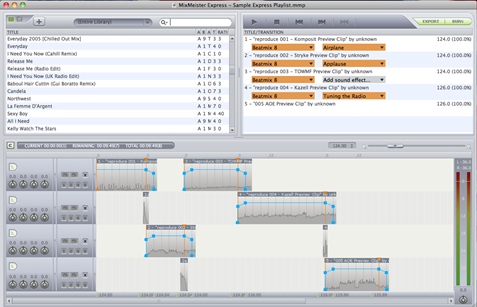
Needless to say, when the email promoting MixMeister Express landed in my inbox, they had my attention. The program’s layout is similar to the loop-based remix software Acid, another toy I played with a lot back when I had more time on my hands. And the way MixMeister analyzes songs and plots transitions from one song to the next is, well, ridiculously smart. In a matter of hours, I had assembled an 80-minute mix, and not a single train wreck in sight.

Populating the database is a breeze (and necessary for the program to determine beats per minute), and adding songs to your mix is as simple as clicking and dragging. (You can even go back and change the order of songs, something that was impossible in ye olden days.) There were several instances where the program would set up a mix to take place at the exact point that I would have chosen on my own, though if it doesn’t, changing the “anchor point” on both the outgoing and incoming song is a breeze. Most of the time, the only tweaking that needed to be done involved the volume settings – it tended to do kill the volume of the outgoing song a little early, and suddenly – but that was an easy thing to adjust. They’ve even come up with a couple flashy transition tricks: the ping pong cut (it jumps back and forth between songs on every half step) and the bass swap (exactly what you think it does). I tended not to use these in mixes, though, as they’re more distracting than a regular beat mix.
Looping was a little more difficult to grasp, which surprised me given my familiarity with Acid, where I had to create the loops manually before being able to use them. There are buttons on the left that are supposed to help you with this, but I found that using the short keys to mark the beginning and end of a loop was much cleaner. And stay on top of the looping, or it will get carried away; I looped the first four bars of Muse’s “Map of the Problematique,” and it just kept going on and on until I hit Stop. (I thought I had it set to loop only four times.) You’ll get very familiar with the Undo function, that’s for sure.
The most curious feature was the Smart Playlist, which will take a group of songs and automatically come up with transitions between them, based on your criteria. (You can create BPM caps, limit to a certain year, etc.) It’s a neat idea, but be prepared to massage the mixes some, rather than clicking Play sight unseen. I threw a handful of tracks together, and the results yielded several train wrecks.
As handy and as efficient as MixMeister Express is, I expect that the old-school DJs will declare it an abomination, since it renders them obsolete…and they have a point, sort of. There is a great quote in “The Incredibles” where weapons manufacturer-turned anti-superhero Syndrome tells his former idol Mr. Incredible that when everyone’s special, no one will be. This software does much the same thing, since it does the majority of the heavy lifting and eliminates much of the guesswork. But relax, fellow DJs: yes, this will enable people who can’t mix vinyl to make pretty good digital beat mixes, but no one is going to use MixMeister in a live scenario. This is purely a bedroom beat mix kind of program, and for someone like me who has two small kids and zero free time, that is exactly what I’m looking for.
MixMeister home page

 We love when good things happen to good bands. The Hours quietly released one of 2009’s finest albums with the sky-high See the Light, and someone at Nike clearly took notice, because the band’s 2006 single “Ali in the Jungle” just scored the company’s recent “human chain” ad, which ran roughly one kajillion times during the Winter Olympics. The song is a killer, with one of those instantly memorable choruses that will serve as the soundtrack for sports montages for generations to come. “Everybody gets knocked down / How quick are you gonna get up?” challenges singer Antony Genn in his Miles Hunt-like tenor, complemented by a punchy piano riff. The EP is short, a mere four tracks – and one of those tracks is an orchestral version of the title track – hence the mere three-and-a-half-star rating, but perhaps they are planning a more proper US release for See the Light later in the year (one song from the album, “These Days,” can be found here), after its brief availability as a download last year. One can only hope, anyway. British pop fans, get this while the getting is good. (Hickory Records 2010)



 “There ain’t no grave that can hold my body down.” So sings the Man in Black on the opening track of what we are assured is truly the final entry in his series of his Rick Rubin-helmed American Recordings albums. It’s been six years since his death, yet if there’s anyone you could believe would make good on such a lyric, it’s Johnny Cash. In that brief interim between losing his beloved wife, June Carter Cash, and losing his own battle against the health issues which had plagued him for several years, Cash entered the studio and cut the material on both this album and its predecessor (American V: A Hundred Highways), but while the sessions may have given him the opportunity to provide his own musical epitaph, listening to material like “I Don’t Hurt Anymore” and “Can’t Help But Wonder Where I’m Bound” serves first and foremost to reopen the old wound left by Cash’s demise. Only after getting past the sense of loss can one truly begin to appreciate American VI…and trust me when I tell you that it’s liable to take you a few spins to reach that point.