
RIYL: Rihanna, Mary J. Blige, Jennifer Lopez
Mariah Carey’s last album, 2008’s E=MC², marked the spot where she broke Elvis Presley’s record for Number One singles by a solo artist – and it also boasted the biggest opening-week sales of her career – but it also ran out of steam pretty quickly, petering out after being certified double platinum, a pretty steep comedown after selling 10 million copies of 2005’s The Emancipation of Mimi. Carey has, in other words, a thing or two to prove with Memoirs of an Imperfect Angel – which is the situation she’s been in pretty much since 2001’s Glitter imploded in what seemed at the time to be a career-destroying cloud of ice cream and cleavage. She has, to her credit, done an outstanding job of staying relevant in the post-Top 40, post-TRL, and largely post-record industry world, even at the much-ballyhooed expense of everything that made her music special in the first place; she has, in fact, reached the point where the splash surrounding every new album is just as important as its musical contents. She’s an artist who’s famous largely because she’s famous – sort of the MTV equivalent of Charo, albeit with a much stronger set of pipes, not that you’d really know it from listening to anything on Memoirs.
From the outside, it’s easy to dismiss everything Carey has done since Butterfly as vapid, cynical catering to the hip-hop generation, and to an extent, that’s more or less true – but each of her albums has its own somewhat self-contained aesthetic, too. E=MC², for instance, put Carey across as the R&B equivalent of the slutty, insane aunt you wanted to have in high school, nattering on about what’s happening in the clubs and dropping embarrassing “hip” references to the things the kids like. That persona has thankfully been retired for Memoirs, but in its place we get a pretty middle-of-the-road Mariah – one who wants to have her trendy cake (the Auto-Tune frosted “Obsessed”) and eat at the Adult Contemporary table, too (the treacly cover of Foreigner’s “I Want to Know What Love Is”). It’s all very polished and calculated, but those are qualities that have been hallmarks of great R&B for more than 50 years; hell, even “Vision of Love” was a Brill Building-worthy piece of airtight songcraft. No one buys Mariah Carey records looking for wild inspiration – but what many of them do want to hear is a reflection of Carey’s singular, once awe-inspiring vocal talent, and that’s what’s missing from Memoirs. It’s a perfectly entertaining modern R&B album, and one not without its eyebrow-raising wrinkles (chief among them the drumline that takes over the beat for the “Up Out My Face” reprise), but one that, ultimately, could have been performed by almost any anonymous singer.
Oh, sure, Mariah wheels out her usual tricks here and there, but instead of showing off that tremendous range, she throws in a few dolphin calls behind another obnoxiously breathy lead vocal (“H.A.T.E.U.”) and calls it even. To be fair, Mariah’s in a tight corner at this point; she’s long since alienated the listeners who expected great things from her after her debut, and her endless trendjacking over the last decade has made her an artist with a record-setting commercial legacy, but no real artistic identity. About the best anyone can hope for at this point is an album like Memoirs – one that’ll make enough small dents in the R&B charts to extend her cultural relevancy for another release cycle while throwing a bone to AC program directors with a song like “I Want to Know What Love Is,” practically guaranteed to linger near the top of the recurrent charts for at least a year. At some point, Mariah will have to stop flaunting her ta-tas and get back to the business of making timeless music, either because she’s no longer got the physical goods or because Aretha Franklin will finally get fed up with her shit and go slap her into being a real diva again. I only hope that, when that moment comes, she still remembers how to, you know, sing. (Island 2009)
Mariah Carey MySpace page

 Normally, one might think of Norway as kind of an isolated place, at least in terms of its being removed from the mainstream. However, considering ex-patriot Sondre Lerche’s ability to absorb soft rock styles and recycle them in his own breathless, breezy style, he’s clearly in sync when it comes to fashioning a radio-ready formula. Lerche’s previous albums have shown a steady evolution in honing his approach and smoothing over the rough edges, ensuring that Heartbreak Radio isn’t only palatable to the masses but possibly his most accessible effort yet. Lerche’s powder-puff vocals are as unobtrusive as cotton candy, but underscored by the teeming pulse and rambunctious strings of “Good Luck,” the staccato rhythm of “If Only,” and the unruly – relatively speaking – posturing of “Easy to Persuade” and “Almighty Moon,” Lerche is mostly able to avoid coming across as completely cloying. Not that he skirts it altogether; the giddy designs of “Words & Music,” the smooth croon of “I Cannot Let You Go” and schmaltzy posturing of “Goodnight” are mired in a syrupy sound best suited to the vacuous airs of an adult contemporary radio format. It stands to reason then that only when its pulse starts pumping, Heartbeat Radio gets its blood flowing. (Rounder 2009)
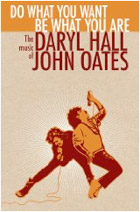 They’ve been feted in countless compilations, but Daryl Hall and John Oates have never received the deluxe box set treatment until now – which seems odd, considering they’re the top-selling duo of all time. The cumbersomely named Do What You Want, Be What You Are: The Music of Daryl Hall John Oates has been in the works for over a decade, tumbling to Legacy when Sony merged with BMG a few years ago, and for once, a corporate mega-merger bears a little artistic fruit; just about everything the duo has done, from pre-H&O recordings with the Masters and the Temptones through their early Atlantic years as a folk/rock act and on into their most recent incarnation as a slick adult contemporary object of Yacht Rock hipster fetishism, is here. The hits are present and accounted for, of course, which is actually what puts a hiccup in Do What You Want’s stride: Is there a Hall and Oates fan on Earth who doesn’t already have at least one of their best-of compilations? Is there any such thing as a “casual” fan of the duo that’s willing to drop coin on a four-disc box? This set tries to play to both groups, lumping in Hall and Oates’ amazing streak of hits alongside a smattering of deep cuts, live performances, and demos. It’s a pleasantly full-figured portrait of their work, but it has the nasty side effect of rendering Disc Three essentially worthless (or, at the very least, utterly redundant) for the hardcore fans who have been waiting for this collection.


