Author: Lee Zimmerman (Page 3 of 20)

Jay Farrar & Benjamin Gibbard: One Fast Move or I’m Gone: Kerouac’s Big Sur


RIYL: Neil Young, Greg Laswell, Hem

It’s fitting that this modest film based on the life of one of America’s most iconic authors would garner a soundtrack composed and performed by two of today’s most compelling alternative musicians, Jay Farrar and Benjamin Gibbard. Jack Kerouac, of course, helped define the underground subculture of the late ‘50s and early ‘60s with his novel “On the Road,” influencing a generation of displaced and rebellious individuals who dared defy the norms of a placid society. While they may not be quite so influential, Farrar and Gibbard’s efforts with Son Volt and Death Cab for Cutie, respectively, have nevertheless had a lingering impact on other artists who have ventured away from the tried and true and immersed themselves in similarly adventurous realms.

Arousing both literary and musical interests, One Fast Move or I’m Gone: Kerouac’s Big Sur documents its subject’s subsequent retreat from a culture he helped create, a period when he hid himself away at poet Lawrence Ferlinghetti’s cabin in Big Sur in an attempt to cope with his doubts and depression. Using Kerouac’s own words, interspersed with commentary from surviving contemporaries and such avowed devotees as Patti Smith, Tom Waits and Robert Hunter, the film explores his shattered psyche and sad circumstance that led to the author’s eventual downward spiral.

In that context, Farrar and Gibbard weave a lilting musical tapestry, one that emphasizes low-lit harmonies, a predominance of acoustic guitars, gentle melodies and a sweep of pedal steel. The 12 songs create a weary ambiance that fits the film’s somber pastiche; fitting midway between the somber sensitivities that characterize Farrar’s usual demeanor and the more effusive sounds that characterize Gibbard’s Death Cab duties, songs such as “California Zephyr,” “Low Life Kingdom” and “These Roads Don’t Move” give the soundtrack an amiable sway and an unobtrusive appeal. Kerouac may furnish the narrative, but Farrar and Gibbard help manipulate the mood while providing the score with its easy appeal.

After one look and a single listen, Gone is not easily forgotten.

One Fast Move webpage

Robyn Hitchcock: I Often Dream of Trains In New York

4/5 Stars
RIYL: Syd Barrett, Bonzo Dog band, XTC

Always the eccentric, predictable only in his unpredictability, Robyn Hitchcock has never been an easy character to decipher, frequently defying easy accessibility and offering only rare opportunity to peer below his songs’ psychedelic sheen and to meditate on his melodies. Consequently, the concert film “I Often Dream of Trains In New York”, is a rare treasure in that it gives a more intimate view of the man and his muse via a thorough track-by-track replay of an early album many consider his signature achievement.

Hitchcock’s no stranger to cinema, of course. Last year’s documentary “Sex, Food, Death… and Insects” offered a surprisingly candid potrait of the artist in creative mode, a follow-up of sorts to the musical portrait captured in Jonathan Demme’s critically lauded “Storefront Hitchcock.” Hitchcock had a cinematic reunion with Demme more recently in fact, when he was given opportunity to perform a pair of songs in Demme’s current film, “Rachel Getting Married,” following up his acting debut as one of the protagonists in Demme’s remake of “The Manchurian Candidate.”

Regardless, it’s Hitchcock’s allure as an artist with a curious magnetism and slightly off-kilter wit and regimen that enthralls his followers, and if “I Often Dream of Trains in New York” seems to strip away that elusive veneer, it doesn’t detract from his charm or appeal. Performing in a stripped-down acoustic setting and backed by multi-instrumentalist Terry Edwards and guitarist Tim Keegan, he revels in the sentiment, sarcasm and wry irony parlayed by such numbers as “Up to Our Nex,” “I Often Dream of Trains,” “America” and “I Used to Say I Love You,” songs that take on an idyllic, folk-like serenity in this live setting. Even so, the a cappella “Uncorrected Personality Traits” brings to mind the bizarre, unabashed silliness of the Bonzo Dog Band, while a cassette recording of “Sometimes I Wish I Was a Pretty Girl” serves as ample reminder of Hitchcock’s penchant for bizarre lyrical twists. It’s fitting then that the tracks are interspersed with Hitchcock’s own commentary on the origins of these songs, relayed, appropriately, from a seat on a train. Likewise, a bonus feature, “Beyond Basingstoke” offers further illumination and enlightenment.

A must-see for all Hitchcock aficionados, “I Often Dream of Trains in New York” is also an ideal passage for the uninitiated. (Yep Roc 2009)

Robyn Hitchcock website

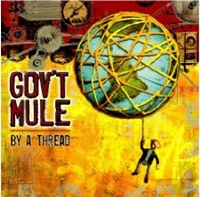
Gov’t Mule: By a Thread


RIYL: Allman Brothers, Robin Trower, Mountain

Gov’t Mule treads that narrow divide that links jam band excess, raucous Southern rock and blustery white boy blues. Founded by guitarist Warren Haynes and the late Allen Woody, both of whom had been drafted to serve with the Allman Brothers during one of the band’s frequent reshufflings, the duo subsequently launched Gov’t Mule as an active side project in the mid ‘90s.

Since then, Gov’t Mule hasn’t digressed all that much from the rambling jams and blustery exhortations that distinguished the music Haynes and Woody created as employees in their day job. In fact, if the band was actually striving to set itself apart, it was never all that evident. For the most part, the group’s recorded catalog has been dominated by concert recordings, which have emphasized their instrumental prowess over more concise songcraft.

To a certain extent then, By a Thread marks something of a turning point in their recording campaign, placing a focus more on the material rather than their usual pyrotechnics. To be sure, there are the usual overwrought growls and howls, as evident in such blazing rampage of “Broke Down on the Brazos,” “Steppin’ Lightly” and “Monday Morning Meltdown,” each a searing onslaught that finds them adhering to more turgid testimonials. On the other hand, “Forevermore” and “Frozen Fear” suggest the band might be willing to treat the material with a hint of subtlety by toning down the more aggressive posturing. Of course, fans need not worry about an abrupt change of course, but it is worth noting that By a Thread might provide something of a kick to Govt Mule’s newer recruits. (Evil Teen 2009)

Gov’t Mule MySpace page

Radney Foster and the Confessions: Revival


RIYL: Steve Earle, Rodney Crowell, Ryan Adams

No doubt about it – Revival is quite an apt title for this latest effort from Texas-bred singer/songwriter Radney Foster. Formerly half of the country pop duo Foster and Lloyd, he’s come a long way towards establishing an Americana brand since initially venturing out on his own in the early ’90s. That said, Revival finds him significantly raising the bar and setting a new standard as far as his own output is concerned. An uplifting, soul-defining statement of unadulterated affirmation, both the messages and melodies linger long after the final notes fade away. The songs soar like expansive anthems, and on tracks such as “A Little Revival,” “Forgiveness” and “Shed a Little Light” those stirring sentiments evoke a spiritual ferocity and unbounded optimism in a manner that’s genuinely affecting. “I Made Peace with God” and “Suitcase” are especially revealing, each a testament to a new-found faith that Foster invokes without hesitation.

Still, it would be misleading to dismiss him solely as a would-be Bible thumper; the rowdy and rollicking “Until It’s Gone” and the carefree abandon of “Trouble Tonight” show Foster still solidly ensconced in secular realms. Newcomers ought to consider this an excellent place to begin, while Foster fans will find this his most indelible effort yet. Clearly, this Revival rates a solid hallelujah and an unqualified amen. (Devil’s River Records 2009)

Radney Foster MySpace page

Without a Face: Worst Debut Album Ever


RIYL: Avett Brothers, Daniel Johnston, They Might Be Giants

When you’re setting yourself up for failure by dubbing your first effort the Worst Debut Album Ever, suffice it to say you’re putting the bar so low that any redeeming quality whatsoever makes it seem as if you’ve succeeded. Then again, considering Henry Dillard’s self-deprecating sense of humor, any pronouncement to that effect is relative anyway. On the surface of it, Without a Face, Dillard’s nom de plume, purveys a slacker mentality, all strumming guitars, unruly ranting and a decidedly irreverent and irrepressible attitude. However, there’s something to be said for the entertainment derived from raucous revelations about substance abuse (“Druggie Love”), obsession with an older woman (“31”) and an ode to the dangers of dairy products (“Lactose Intolerance”). And with a goofy hillbilly phone chat (“Worst Intermission Ever”) tossed in for good measure, it seems that Dillard’s guile resides in his ability to play the fool and make the lowest common denominator appear a form of high art. Okay, so Worst Debut Album Ever may not aspire to be anything more than what its name implies, but its unabashed honesty conveys a charm all its own. (Redbird Records)

Without a Face MySpace page

« Older posts Newer posts »