Page 152 of 583

Rihanna: Rated R


RIYL: Keri Hilson, Amerie, Jordin Sparks

Lest you think Rihanna meant to make some kind of cute alliterative play by naming her fourth album Rated R, she quickly disabuses any such notions by getting down to business with a collection every bit as inappropriate for young ears as its title would suggest. “I’m such a fuckin’ lady,” she purrs in the second track, “Wait Your Turn,” and from there it’s off to war. When last we heard from Rihanna, she was urging us to stand under her umbrella; this time out, she’s more focused on letting us know how hard she is, bragging about licking her gun because “revenge is sweet,” and barking “Get it up … is you big enough?” The music reflects this lyrical left turn; the arrangements are braced with metallic, tricked-out beats, cold, buzzing synths, and stacks of raw electric guitars (that’s Slash you hear on the ridiculous “Rockstar 101,” which finds her boasting, “Rocking this club / Got my middle finger up / I don’t give a fuck”).

Rihanna_06

It’s a curious blend, really, because as aggressive as Rated R wants to be – and often is, craptastic ballads like “Stupid in Love” and “Te Amo” notwithstanding – Rihanna can never get past her steel-plated drone of a voice long enough to really make it work. More than anything, she just sounds bored, whether she’s declaring herself a “gangsta 4 life” or strolling her way through a duet with will.i.am. This doesn’t blunt the impact of Rated R’s best moments, like the thudding “Hard” and softcore porn of “Rude Boy”; taken in total, it can even function as a sort of meta statement on the emotional disconnect between mainstream culture and its young consumers. In a pop climate where lack of emotion is the norm, Rihanna’s bloodless art makes perfect sense. Still, after a while, it’s impossible not to wish for some good old-fashioned passion. Remember when R&B had soul? (Def Jam 2009)

Rihanna MySpace page

Morningwood: Diamonds & Studs


RIYL: Pat Benatar, Garbage, Paramore

The manner in which success has eluded New York’s Morningwood (previously a quartet, now a duo) is frankly surprising. Their songs are armed to the teeth with punchy guitar riffs, and singer Chantal Claret is an absolute belter, a larger than life personality with an oversized libido to match. (Think Pat Benatar, only this time you actually have a shot at getting her in bed.) After a one-album stay with Capitol, Morningwood has elected to go the self-released route with their sophomore effort Diamonds & Studs (though MTV is assisting with the distribution), and unlike most self-made affairs, this album sounds damn good. Indeed, it’s a modern-day production with an old-school mix job, lacking the overcompression that makes most contemporary albums sound like complete and utter shit. Much like the band’s debut, a few songs stand head and shoulders above the others, namely “Sugarbaby,” which out-Paramore’s Paramore. “How You Know It’s Love,” which jumps from shuffle beat to four-on-the-floor rocker in the chorus, playfully cribs from the band’s “Nth Degree,” and the drum-heavy “That’s My Tune” has ‘club smash’ written all over it.

Strangely, as pleasant as the album sounds while it’s playing, much of it leaves no footprint once it’s gone. Case in point: “Three’s a Crowd.” Fabulous while you’re listening to it, but an hour later, it’s hard to remember how it goes. Morningwood is still putting the pieces together, but there are far worse bands that are out-selling them. Pity. (Morningwood Inc. 2009)

Morningwood MySpace page
Click to buy Diamonds & Studs from Amazon

Jay Farrar & Benjamin Gibbard: One Fast Move or I’m Gone: Kerouac’s Big Sur


RIYL: Neil Young, Greg Laswell, Hem

It’s fitting that this modest film based on the life of one of America’s most iconic authors would garner a soundtrack composed and performed by two of today’s most compelling alternative musicians, Jay Farrar and Benjamin Gibbard. Jack Kerouac, of course, helped define the underground subculture of the late ‘50s and early ‘60s with his novel “On the Road,” influencing a generation of displaced and rebellious individuals who dared defy the norms of a placid society. While they may not be quite so influential, Farrar and Gibbard’s efforts with Son Volt and Death Cab for Cutie, respectively, have nevertheless had a lingering impact on other artists who have ventured away from the tried and true and immersed themselves in similarly adventurous realms.

Arousing both literary and musical interests, One Fast Move or I’m Gone: Kerouac’s Big Sur documents its subject’s subsequent retreat from a culture he helped create, a period when he hid himself away at poet Lawrence Ferlinghetti’s cabin in Big Sur in an attempt to cope with his doubts and depression. Using Kerouac’s own words, interspersed with commentary from surviving contemporaries and such avowed devotees as Patti Smith, Tom Waits and Robert Hunter, the film explores his shattered psyche and sad circumstance that led to the author’s eventual downward spiral.

In that context, Farrar and Gibbard weave a lilting musical tapestry, one that emphasizes low-lit harmonies, a predominance of acoustic guitars, gentle melodies and a sweep of pedal steel. The 12 songs create a weary ambiance that fits the film’s somber pastiche; fitting midway between the somber sensitivities that characterize Farrar’s usual demeanor and the more effusive sounds that characterize Gibbard’s Death Cab duties, songs such as “California Zephyr,” “Low Life Kingdom” and “These Roads Don’t Move” give the soundtrack an amiable sway and an unobtrusive appeal. Kerouac may furnish the narrative, but Farrar and Gibbard help manipulate the mood while providing the score with its easy appeal.

After one look and a single listen, Gone is not easily forgotten.

One Fast Move webpage

Leona Lewis: Echo


RIYL: Christina Aguilera, Whitney Houston, Kelly Clarkson

Leona Lewis has a beautiful voice – clear, strong, and remarkably non-susceptible to the sort of melismatic dicking around that far too many pop vocalists seem to think passes for singing. It’s the type of voice that begs to be dropped in front of a sympathetic band and some truly tremendous material, and using it to record synthetically produced, pleasantly anonymous pop songs is a little like bringing a cannon to a knife fight: a tremendous waste of perfectly good ammo. Of course, not every song can be a standard, but c’mon – Sony BMG is one of the biggest corporations on Earth, and they can definitely afford better material than the middle-of-the-road fluff Lewis is saddled with here. She’s definitely game – in fact, her voice rings so brightly that she almost manages to transcend the uniform ordinariness of the material – but the ultimate effect is never more than mindlessly entertaining. Which is probably precisely the point of an album that was clearly assembled with such an eye toward big-picture chart domination that the finer details – like finding great songs, for instance, or not lumping Lewis’ gourmet voice in with a duet partner as proudly, generically vanilla as OneRepublic’s Ryan Tedder – were somehow forgotten. Echo is fine, for what it is – but like Lewis’ similarly pedestrian debut, it could have been much, much more. (RCA/19 2009)

Leona Lewis MySpace page

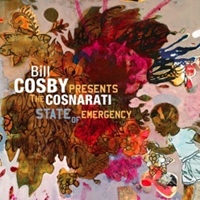
Bill Cosby Presents the Cosnarati: State of Emergency


RIYL: It’s a bit hard to say, really

The idea of any 72-year-old man supervising the recording of a hip-hop record is sort of ridiculous on its face, but Bill Cosby? The guy whose beef with rap culture’s profane streak has only deepened since being immortalized in Eddie Murphy’s “Raw” more than 20 years ago? The sweatered sitcom savior and Jell-O pitchman has made a second career out of delivering cranky missives to the black community, and from a distance, Bill Cosby Presents the Cosnarati: State of Emergency looks like just another lecture about not dropping out of school, taking care of your kids, staying off drugs, and keeping your language free of all that awful filth, flarn, flarn, flarn, filth. Which it is, sort of, but here’s the thing – as a hip-hop record, State of Emergency is surprisingly sound. Okay, so it won’t win any awards for innovative production, and yes, it does include a few painful rhymes, but it’s far from the unintentionally hilarious train wreck you might expect. And even if he’s alienated some with his heavy-handed speechifying, this album reinforces the fact that his heart has always been in the right place. Still, there’s no denying that Public Enemy was pioneering socially conscious hip-hop 20 years ago – and delivering it with more passion, more style, and a more profound impact. It’s also hard, given Cosby’s career and strident reputation, to imagine who’s going to listen to this album with open enough ears to hear it for what it really is. It’s ultimately just a curiosity, albeit a well-made one; perhaps next time, Cos can use a few name-brand MCs to get his point across. (Turtle Head 2009)

Bill Cosby MySpace page

« Older posts Newer posts »