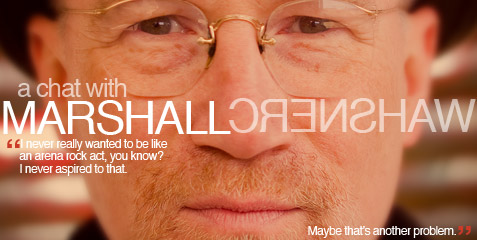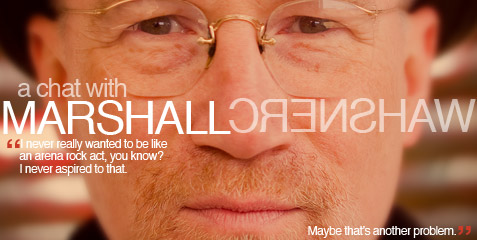
Talking with Marshall Crenshaw is like being invited to the rock ‘n roll grown-up table. After minding your manners at the kid’s table for years, you finally get the chance to show your elders how much you’ve learned about music…only to realize just how little you know. The man is an encyclopedia of rock, which makes sense when you consider that he played John Lennon on the stage, Buddy Holly in the movies, and wrote the instructions for fictional rocker Dewey Cox on how to walk hard. On the eve of a series of shows on both sides of the pond in support of his new album Jaggedland, Crenshaw spoke with Bullz-Eye about how he never wanted to be an arena guy, and offers his two cents on some of the cover versions of his songs. He also explained why he inadvertently terrified his interviewer at a concert six years ago, but that story is off the record.
BE: I would just like to state that there should be a law that forbids you from taking six years between albums.
MC: I know, it’s funny, isn’t it? But that’s how long it took, I guess. My friend Don Dixon said everybody should do a record every four years, and no sooner than that. I don’t know where he got that from, but I guess that’s just what his body clock tells him. Anyway, yeah, I know, six years is a long time. But it was worth it, you know? It was worth taking the extra time and the extra care, I think.
BE: I read that it was Jerry Boys’ work on the Ry Cooder album that attracted you, but I’m sure it didn’t hurt that he also recorded the Beatles.
MC: You know what? I found that out fast, because I have that book, there is a book called “The Beatles Recording Sessions.” When it came out I just read it and read it and read it, like it was the Bible. So I had seen his name in there but I didn’t make the connection when I bought Mambo Sinuendo, and just proceeded to fall in love with it. Then I went on to his website and I went, “Oh yeah, right.” But that’s only just the beginning of the story with him. I mean, God, you’ve got to really give it up for guys who are…you know, just have that deep of a well of experience and have done that much really high-quality work.
BE: Did you ever have designs of making an Imperial Bedroom-type record with a Geoff Emerick or an Alan Parsons?
MC: No, none of those guys ever crossed my mind. I mean, with all due respect, and so on and so forth. And again, the record that really made me think of Jerry Boys is a record where everybody just sat in the room and played at the same time, you know, Mambo Sinuendo. There are some tracks that are really heavily crafted and edited and stuff like that, but mostly it’s just guys in a room, and the sound of the room. That was what I dug about that record.
BE: Have you ever reached a point where you thought to yourself, “Screw the solo career, I’m going to write songs for Disney artists,” or “I’m going to write songs for up and coming country singers”?
MC: Yeah, I have. Sure, of course. I mean, I have even done the first one. I did a project for Disney Television Animation. I worked on it for about half a year, wrote about a half-dozen songs for an animated sequel to “101 Dalmatians.” It’s been sort of an oddball, patchwork sort of a résumé with me, really. The main thing is my records and my songs, that’s really what it’s about. But I’ve taken lots of side trips. I was in “La Bamba.” One of my songs right now, “You’re My Favorite Waste of Time,” is in a breakfast cereal commercial in Europe.
BE: That makes sense, since it was a big hit for Owen Paul in the UK.
MC: Yeah, you know about that.
BE: Yes. And I just recently heard Bette Midler’s cover of the song, which I can’t say I share the same enthusiasm for.
MC: I was delighted when she recorded it…anyway, what was I saying? Oh, the Nashville thing. Yeah, I had a publisher and a good friend who used to constantly encourage me to go to Nashville. And I did try it, I went there and dabbled in it a little bit, I just could never get that motivated, you know? For better or for worse, the thing I really love is record-making. I just think it’s a great art form. When it comes to the idea of making a record and creating a body of songs for a record, that’s when I really get motivated, you know? But the Nashville thing just sort of never felt like the right direction for me.
To read the rest of Bullz-Eye’s interview with Marshall Crenshaw, click here.