Author: Jeff Giles (Page 9 of 41)

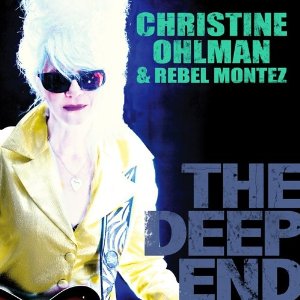
Christine Ohlman & Rebel Montez: The Deep End


RIYL: Etta James, Bonnie Raitt, Kim Lembo

She’s been appearing on albums since the early ‘70s, but if you know Christine Ohlman at all, it’s because of her long (and supremely beehived) stint as a member of the Saturday Night Live Band. Ohlman’s a tenured member of the New York City session crew that produced fellow TV vets like Paul Shaffer and G.E. Smith; it’s a group stocked to the brim with incredible musical talent, but – as Shaffer and Smith’s sporadic recordings attest – not the first place you look if you want to hear inspired songwriting.

Happily, Ohlman’s an exception to this rule, which might have something to do with why her sixth solo release, The Deep End, is crowded with an eyebrow-raising list of guest stars that includes Ian Hunter, Al Anderson, Dion, Marshall Crenshaw, and Levon Helm. Fifteen songs and nearly an hour in length, The Deep End has its perfunctory moments, but it’s as expertly played as you’d expect, and it hits its targets more often than not. In fact, it’s one of the few modern blues records that cops a convincing ‘tude and remembers to bring some real songs to the table. It might be tempting to look at Ohlman in her shades and towering hair, read hackneyed song titles like “The Cradle Did Rock” and “Everybody Got a Heartache,” and wave off the whole thing as just another wine cooler blues record, but don’t judge too quickly – The Deep End lives up to its title. Dive in. (Horizon Records 2010)

Christine Ohlman MySpace page

Goldfrapp: Head First


RIYL: Olivia Newton-John, ABBA, Giorgio Moroder

Based purely on the duo’s reputation, you might think a new Goldfrapp album would be filled with the kind of trendsetting, cutting-edge synthpop that led Christina Aguilera to hire them as collaborators, but with Head First, Will Gregory and Alison Goldfrapp don’t have the future on their minds; instead, they’ve hairsprayed Goldfrapp’s breathy vocals to a pillowy cloud of New Wave synths and turned the clock back to 1981. Close your eyes, and the resemblance to Olivia Newton-John is uncanny – the title track, in particular, sounds like a lost ON-J hit from decades ago. It’s kind of fitting that this album is coming out the same week as John Cusack’s “Hot Tub Time Machine.”

Goldfrapp_06

In the wrong hands, this would be empty-calorie cheese, but Head First doesn’t sound like a cheeky exercise in retro irony – it really sounds like it came from the era it’s imitating, and although it’s true that the era in question was responsible for plenty of cruddy synth disco, this is no guilty pleasure, nor does it fall prey to the genre’s many campy pitfalls. If you’ve ever wanted to lace up your roller skates and pretend “Can’t Stop the Music” never happened, Head First might very well be your new “Xanadu.”

Of course, there really was a “Can’t Stop the Music,” and in the long run, Goldfrapp can’t pretend the last 25 years never happened any more than you can, which ultimately makes Head First little more than a really well-crafted stylistic detour – and, as a result, something of an artistic dead end. But so what? Dig your leg warmers out of storage and enjoy one of the sweetest bursts of pure pop pleasure you’re likely to hear all year. The artists that fell along this particular axis of ‘80s synth pop had their drawbacks, but their near-total lack of cynicism or irony was one of their biggest charms, and Goldfrapp has recaptured that spirit perfectly here. Do yourself a favor and follow their lead. (Mute 2010)

Goldfrapp MySpace page

She & Him: Volume Two


RIYL: Linda Ronstadt, The Mamas & the Papas, Rosie Thomas

There’s a pretty short list of things you can reasonably expect from an album titled Volume Two, which probably has a lot to do with why Zooey Deschanel and M. Ward decided to use it for their sophomore effort – like their first album, it’s a slight, competently crafted set of retro-evocative mid-tempo numbers, a sort of thrift store trip through the Laurel Canyon pasts of female singers like Linda Ronstadt and Laura Nyro, and by giving it this title, Deschanel and Ward might have been trying to deflect some of the crushing hype that’s dogged them since they announced their collaboration.

Can’t blame ‘em for trying. Actually, they could have tried a little harder – like the first outing, Volume Two has a lazy, tossed-off feel; nothing here is bad enough to make you switch it off, but neither does much of the record stand out. Deschanel’s gotten a lot of credit for being an actor with a real, live singing voice, just as Ward’s been applauded for giving his recordings a warmly authentic retro vibe – but singers are supposed to be able to sing, and music isn’t supposed to need computer gimmicks. All the She & Him hype is based around giving the band credit for things that are supposed to come naturally to musicians, which is puzzling. When did indie rock turn into the Special Olympics?

That might sound a little harsh for an album this offhandedly charming, but there’s no getting around the fact that She & Him intentionally beggar comparisons to better bands, and their music sounds awfully hollow in the bargain. Deschanel sings about heartbreak, and Ward lays on the pedal steel like syrup, but there’s a smirking detachment lurking behind the whole thing that sounds like play-acting. It’s most evident when they try and tackle a page from a truly great songbook – as with Volume Two’s ill-advised cover of NRBQ’s “Ridin’ in My Car” – but it’s always there. You’re better off revisiting the work of the band’s most obvious influences and working your way forward from there. (Merge 2010)

She & Him MySpace page

Reblog this post [with Zemanta]

Broken Bells: Broken Bells


RIYL: Danger Mouse, The Shins, Beck

The latest collaborative project involving the seemingly indefatigable Danger Mouse (billed here under the name his mama gave him, Brian Burton), Broken Bells presents the music press with its first opportunity for hype overload in 2010. One half of Gnarls Barkley teaming up with Shins guitarist and singer James Mercer? Are you kidding? This album doesn’t have a prayer of being reviewed objectively – which is probably why Burton and Mercer kept Broken Bells under wraps until late last year, when they digitally released the album’s first single, “The High Road,” to thunderous online applause.

The full-length is finally here, and here’s the bad news: None of it’s as deliciously addictive as “The High Road.” On paper, Broken Bells looks like the type of album that’s so cracked it either has to be terrific or abysmal, but in reality, it’s just sort of a pleasant listen – which is ultimately disappointing, because if nothing else, you expect to be provoked by any project that places its creative principals in unfamiliar surroundings.

Broken_Bells_01

Broken Bells, though, keeps the listener at arm’s length; like a lot of Burton’s work, there’s a coolness about it that starts to feel pretty chilly after a while. The production is undeniably interesting – this is definitely a headphones record – but all the swirling, blooping synths, distortion effects, and layers of ghostly sound can’t obscure the album’s lack of an emotional center. This probably sounds harsher than Bells deserves – it isn’t a bad album at all – but with this much talent in the studio, who wants to award partial credit?

Listening to Bells’ third track, “Your Head Is on Fire,” you’re struck by the beautiful emptiness of it all – spectral vocals floating between stacks of synths and subtle guitars, with Beach Boys harmonies unspooling around sonar sound effects. Problem is, that’s the record in a three-minute nutshell: Sweet pop melodies and a musically adventurous spirit, drowned mercilessly in a sea of frictionless sound. Broken Bells is a pretty enough place to visit, but don’t plan on staying long – or if you do, bring your warmest winter coat. (Sony 2010)

Broken Bells MySpace page

Peter Gabriel: Scratch My Back


RIYL: Brian Eno, David Byrne, Harold Budd

On paper, covers projects don’t get much more intriguingly wacky than this: Scratch My Back finds the ever-restless Peter Gabriel covering 12 songs by other artists, to be followed with I’ll Scratch Yours, in which those same artists cover Gabriel’s catalog. Oh, and since it’s never a Peter Gabriel album without some kind of twist, he decided to record his end of the bargain with an orchestra. And did we mention the artists he covered? David Bowie, Paul Simon, Bon Iver, Talking Heads, Lou Reed, Arcade Fire, Randy Newman, Neil Young, and Radiohead are only some of the famous (and mostly très hip) names who get scratched here – if ever there was an album that had a snowball’s chance of uniting the Pitchfork and Goldmine crowds, this is it.

On paper, anyway. In reality, Scratch My Back never comes anywhere near the zany generational/stylistic mash-up its concept suggests; in fact, it might end up being one of the more wildly divisive recordings of Gabriel’s long, proudly obstinate career.

How the album hits you will have a lot to do with what you expect. Given his track record, you might think Gabriel would use the orchestral setting to explore the expanded dynamic possibilities of the music by tinkering with polyrhythms and layers – just imagine what a healthy-sized string section could do with Simon’s “The Boy in the Bubble” – but that isn’t the case. Really, aside from a few outbursts, this is a pretty sedate album; Gabriel’s overall approach is pretty well summed up with his morose, sleepy take on “Bubble,” which at least shows up early enough in the track listing to give you a hint of what’s to come.

So it isn’t everything it could have been, and may strike some listeners as something of a disappointment at first, but don’t be quick to dismiss Scratch My Back: Like most Gabriel records – especially his recent efforts – it’s a grower. Most covers albums are an opportunity for the artist to let loose and have a little fun with songs they love, and to try and add their own voice to someone else’s refrain. But not Gabriel – even at his commercial peak, he was an insular artist, and here, he mostly sounds like he’s running through some old favorites for his own benefit. The result is an album that opens slowly: With the exception of the slow-building “My Body Is a Cage” and his take on Regina Spektor’s “Après moi,” which comes barreling out of the gates, much of Scratch initially comes across as a bit of a beautiful snooze. Be patient, though, and Gabriel rewards you with a work of tender intimacy – and he makes Lou Reed and Neil Young sound positively tuneful in the bargain: His covers of “The Power of the Heart” and “Philadelphia” are two of the album’s highlights. In today’s heavily compressed sonic landscape, Scratch My Back may register as little more than an echo at first, but it’s rare we get to hear music with this kind of simple focus, or stark beauty. If it’s still hard not to wish Gabriel had wandered a little further afield with his interpretations, well, we still have I’ll Scratch Yours to hope for. (Real World 2010)

Peter Gabriel MySpace page

« Older posts Newer posts »