Category: Artists (Page 124 of 262)

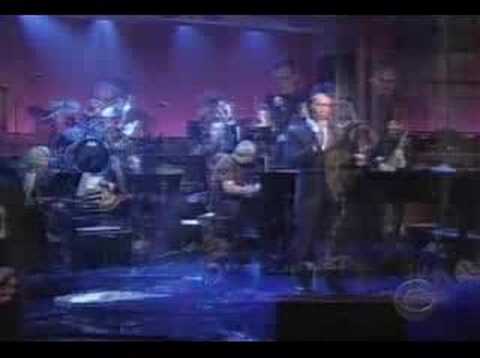
Less Talk, More Music: Paul Anka on “The Late Show with David Letterman”

Sure, it reads as a novelty – Paul Anka does swing covers of mainstream and alt-rock hits – but if you’ve ever actually heard Rock Swings, you know it holds up for the long haul as an instant party in convenient CD form. Rather than take the easy way out, most of the tracks have been dramatically rearranged to work within Anka’s concept, but if you’re convinced that he couldn’t possibly accomplish it with one of the most anthemic songs of the 1990s (if not all of music history), take a listen and enjoy being proven wrong:

Chalk up another entry for future “Proof that the Grammy Awards Are Out of Touch with Reality” lists

Give the Grammy Awards credit for getting a few things right this year: they gave Amy Winehouse the Curse of the Best New Artist (not that she hasn’t already put herself on the fast train to Hell), hooked her up with Best Female Pop Performance and Record of the Year and Song of the Year for “Rehab,” and gave Back to Black the award for Best Vocal Pop Album. Somewhere between all those Winehouse wins, they even let Vince Gill take home the Best Country Album for the sprawling masterwork that is These Days.

Gill also got in one of the two best zingers of the night after he was presented his award by Ringo Starr. “I just got an award presented to me by a Beatle,” he said, then pointed at a specific individual in the audience and asked, “Have you had that happen yet, Kanye?

(The other great line, by the way, was Prince throwing off the snarky comment about Alicia Keys’ virtual duet with Ol’ Blue Eyes, saying, “Frank Sinatra looked good for 150, didn’t he?”)

But, c’mon, people: whether it’s a good album or not, you’re just setting yourself up for ridicule by giving the Album of the Year award to Herbie Hancock’s River: The Joni Letters. It’s just Steely Dan’s Two Against Nature all over again…

From Across the Pond: The Hoosiers, “Goodbye Mr. A”

You’d be well within your rights to be skeptical about the quality of music put out by a band that releases their debut album in four different color schemes. (Collect ’em all, kids!) As it happens, however, The Hoosiers – a London-based trio that’s 2/3 British and 1/3 Swedish – are writing and releasing some awesome pop music. Someone suggested that their tunes approximate what The Feeling would sound like if they actually let loose once in awhile, and I can hear that. Dig their biggest UK hit to date: “Goodbye Mr. A.” Our good friend David Medsker will, within mere seconds after hitting “play,” understand exactly why I felt obligated to avoid the formalities and offer the song immediate inclusion in the WillPop 101 syllabus…yes, it’s just that damned poppy…and to go with a superhero-inspired video to boot? Well, that’s just an extra layer of sugar-sweet icing on the WillPop cake.

(FYI, the last time I embedded the video, it was deleted from YouTube, so if the same happens with this one, then this official non-embeddable version is right here.

WTF?! Flashback – Garth Brooks


The Life of Chris Gaines

By 1999, pop country superstar Garth Brooks had done it all in terms of CD sales, hit singles, sold out concerts, and achieving a massive fanbase who thought their icon could do no wrong. Indeed, even Brooks thought himself that he could do no wrong, and decided to “branch out” as it were, with little fears that his legions of faithful would support him in his new endeavor. That endeavor you ask? Certainly you haven’t forgotten already. Yes, I’m talking about the giant goose egg alter ego Brooks created in his monster lab known as “Chris Gaines.”

You see, Garth wanted to be a pop star just as much as a pop country star, but possibly felt like his fans would abandon him if he was actually ballsy enough to just say, “Hey, I wanna try to gain some new fans, so I’m going to release a pop album” and not do it under some goofy facade. Jazz artists do it all the time by going the pop route. Pop and rock artists go country occasionally as well. So what the hell was Brooks thinking? It may have actually just been a case of his ego finally taking over his creativity.

A “Behind The Music” special was created for fake artist Gaines, and he also appeared as the musical guest on “Saturday Night Live” the week Brooks hosted. The resulting album Garth Brooks in…the Life of Chris Gaines was intended as a precursor to a feature-length film entitled “The Lamb” that would star Brooks as Gaines and really get the wheels rolling on the project. Yeah…it doesn’t take much foresight to see how oddball this whole idea was, and the Chris Gaines album quickly became a resounding dud, even though it peaked at #2 on the Billboard album chart and actually scored Brooks with his only Top 40 pop hit “Lost in You.”

But the fans were wary and didn’t embrace the character in the long run. The movie studios also took note of this and “The Lamb” was forever shelved. After all this, Brooks’ career was never quite the same as pre-Gaines, though he still retained the rabid fans. He has gone into a semi-retirement, recently appearing again to do a limited series of shows. Like “From Justin to Kelly,” “Cool as Ice,” and the film version of “Magical Mystery Tour,” The Life of Chris Gaines will forever be the WTF blight on Garth Brooks’ career.

Deep Cuts: The Clash

(Written by Una Persson)

For a band that was together for only 10 years, The Clash looms large in rock music history. They were one of the most successful bands to come out of the original wave of British punk rock in the late ‘70s, stand as icons for the entire punk rock movement (along with the Sex Pistols, of course), and, unlike most of their punk peers, could actually play their instruments. They also eschewed the nihilism and anarchy of many of their contemporaries for a more politicized, highly charged left-wing lyrical and ideological stance. Their seminal London Calling makes rock critics and Top Whatever list makers swoon. They only struck gold in America toward the end, with “Should I Stay or Should I Go” and “Rock the Casbah,” but from the outset, The Clash infused their brand of punk with a variety of other musical styles, from ska, reggae and dub to rockabilly, jazz, dance and anything else they thought would fit their punky musical stew. In fact, this edition of Deep Cuts takes a deep dive into one of those musical styles: The Clash, reggae-stylee.

“Police & Thieves” – The Clash
Junior Murvin and Lee ‘Scratch’ Perry’s mid-‘70s international club hit was recorded almost as an afterthought when The Clash were recording their first album (the band used to fool around with it in rehearsals), but it stands as one of the first instances of a rock band integrating reggae into their mix (the very first being Eric Clapton’s version of Bob Marley’s “I Shot the Sheriff” in 1974). Lots of first-wave British punks loved reggae and dub; The Clash were one of the few bands who actually incorporated it into their repertoire (one of the few bands of that era that had the musical chops to pull it off, most likely).

“(White Man) in Hammersmith Palais” – The Clash
First released as a single, and only included on the US version of The Clash’s debut album, Joe Strummer’s commentary on multi-culturalism, violence, race relations, class distinctions and other state-of-Britain affairs showed the band to be already head-and-shoulders above their punk brethren both musically and politically. The slow reggae burn throughout most of the song is decidedly different fodder than their early fans had already gotten used to from the band.

Give ‘Em Enough Rope
A decent album, not their worst (Cut the Crap holds that distinction) but far from their best, marred as it is with heavy-handed production and mixing. But, sorry, nothing even remotely reggae-sounding on any of the tracks.

“Wrong ‘Em Boyo” – London Calling
A revisiting of the Stagger Lee myth set to a rollicking ska beat.

“The Guns of Brixton” – London Calling
A sick dread skank, and the band’s first real experiment with dub (a reggae offshoot that overemphasizes the bass and drums, and blends in myriad other sounds and production and engineering techniques not part of a reggae song that evinces punk’s political violence.

To view the rest of the Clash deep cuts, click here.

« Older posts Newer posts »