RIYL: Bryan Adams, Bob Seger, Glenn Frey
 It still hardly seems possible to those of us who remember the gleefully profane, barely conscious persona he cultivated with his first four albums (including his 1998 breakthrough Devil Without a Cause), but Kid Rock has somehow become the heir apparent to Bob Seger’s Motor City rock ‘n’ roll throne. In fact, modern rock is such a graveyard that Rock is damn near an elder statesman of the genre – the kind of artist who routinely draws fawning reviews from Rolling Stone, along with interviews where he’s given a forum to roll his eyes at Steven Tyler joining the judges’ table on “American Idol.” Actually, on that last count, Rock’s no guiltier than the rest of us. But you get the point – that stringy-haired honky rapper with the glassy-eyed stare and the fedora-and-wife-beater wardrobe was never supposed to grow up and give us songs like “Rock N’ Roll Pain Train,” “Rock N’ Roll,” “Rock N Roll Jesus,” and “Rock On.”
But here we are with Kid Rock’s eighth(!) studio album, the flag-wrapped Born Free, offering up a dozen mind-numbingly bland alternatives to actual old-time rock ‘n’ roll. If Seger’s classic records are as solidly unassuming as a cold can of Stroh’s, consider Born Free the equivalent of Natty Light – it’s cheap, and it’ll get the job done if you’re desperate enough, but it really should be better. Really, for the most part, this sounds a lot like an early ’90s Bryan Adams record – which is sort of fitting, considering that Adams’ Canuck take on heartland rock was just as counterfeit as this corny, Rick Rubin-produced collection of would-be anthems and motel ballads.
It feels strange to miss the guy who made songs as proudly brain-dead as “Bawitdaba,” but at least that song had balls and a dangerous vibe, however slight; these days, Rock’s gelded, commercial-ready music is slickly competent at best. On the Born Free album cover, he’s reclining in the back of a convertible, feet up on the seats, amber waves of grain in the background. You can’t tell that the car is rolling gently down the middle of the road, but you can definitely see that no one’s in the driver’s seat. (Atlantic 2010)


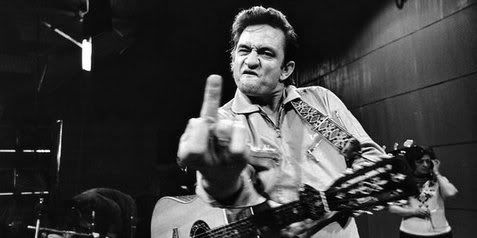
 “There ain’t no grave that can hold my body down.” So sings the Man in Black on the opening track of what we are assured is truly the final entry in his series of his Rick Rubin-helmed American Recordings albums. It’s been six years since his death, yet if there’s anyone you could believe would make good on such a lyric, it’s Johnny Cash. In that brief interim between losing his beloved wife, June Carter Cash, and losing his own battle against the health issues which had plagued him for several years, Cash entered the studio and cut the material on both this album and its predecessor (American V: A Hundred Highways), but while the sessions may have given him the opportunity to provide his own musical epitaph, listening to material like “I Don’t Hurt Anymore” and “Can’t Help But Wonder Where I’m Bound” serves first and foremost to reopen the old wound left by Cash’s demise. Only after getting past the sense of loss can one truly begin to appreciate American VI…and trust me when I tell you that it’s liable to take you a few spins to reach that point.