Month: February 2010 (Page 1 of 9)

Listen to Prince’s new song, “Cause and Effect”

It’s been awhile since we heard from Prince, hasn’t it? Good news is the royal one is still on his game, proven by his new song, “Cause and Effect,” now streaming over 89.3 The Current, a Twin Cities public radio station. The tune is upbeat, silly, and might even entice you to leave the house.


Photo from fOTOGLIF

Beth Thornley: Wash U Clean


RIYL: Aimee Mann, Anya Marina, Ben Folds

It takes real talent to create music that is hip, yet melodic; accessible, yet not forced; and catchy yet not catchy to the point that you don’t want to listen after five spins. Piano songstress Beth Thornley has done this on her third album, Wash U Clean, a bouncy collection of pop tunes that are as infectious as any piano-driven ditties you’ve ever heard. Thornley herself is apparently amazed at the variation between the artists she is compared to, but that’s because that variation is genuinely as wide as the Grand Canyon – even from track to track. That’s just one of the many reasons to like this terrific set of music, and it’s a bonus that you’ll feel as cool as some hipster blogger while listening to it. The title track features a horn riff that will remind you of the synthesizer in Gary Numan’s “Cars,” but the soaring chorus is like one of those long-lasting wads of bubble gum. From there, Thornley weaves in and out from Ben Folds-like anthem (“Still Can’t Hide” and “It’s Me”) to the Aimee Mann-ish “There’s No Way” to the best track of all, the stunning ballad “What the Heart Wants” – the musical version of a lazy Saturday afternoon. Beth Thornley has really delivered a beauty with Wash U Clean, and you’ll be hard pressed to find a bad song on it. (Stiff Hips 2010)

Beth Thornley MySpace Page

Jason Castro: The Love Uncompromised EP


RIYL: Amos Lee, Michael Tolcher, Daniel Powter

Good luck trying to compare former “American Idol” finalist Jason Castro to anyone, because dude is clearly blazing his own trail. At times, you’ll hear elements of the artists listed above, and in the opening track of Castro’s The Love Uncompromised EP, he even channels Green Day’s Billie Joe Armstrong. When Castro was on “Idol,” he played the part of the jam band stoner hippie, and he played it well. But one thing everyone knew about Castro was that, as Randy Jackson would say, he could “really sing, dawg.” And that remains the case today, but even better is the fact that Castro writes some nice, memorable songs that do not seem forced. The opener, “Let’s Just Fall in Love Again,” is acoustic and has some corny lyrics about falling “disgustingly” in love, but after that the fully produced fare is melodic with nice rhythmic arrangements – especially “Love Uncompromised,” which has a sort of reggae feel, and the bouncy “If I Were You.” But the best track of all is the riveting ballad, “Sweet Medicine,” which has the tenderness and soul of some of Amos Lee’s best material. The EP will leave fans wanting more, and that’s okay because this one is only available digitally and at Castro’s shows, but the full-length will be out this spring. Sometimes former “Idol” hopefuls tank, and sometimes they soar – and Jason Castro has the goods to be in the latter category. (Atlantic 2010)

Jason Castro’s website

Peter Gabriel: Scratch My Back


RIYL: Brian Eno, David Byrne, Harold Budd

On paper, covers projects don’t get much more intriguingly wacky than this: Scratch My Back finds the ever-restless Peter Gabriel covering 12 songs by other artists, to be followed with I’ll Scratch Yours, in which those same artists cover Gabriel’s catalog. Oh, and since it’s never a Peter Gabriel album without some kind of twist, he decided to record his end of the bargain with an orchestra. And did we mention the artists he covered? David Bowie, Paul Simon, Bon Iver, Talking Heads, Lou Reed, Arcade Fire, Randy Newman, Neil Young, and Radiohead are only some of the famous (and mostly très hip) names who get scratched here – if ever there was an album that had a snowball’s chance of uniting the Pitchfork and Goldmine crowds, this is it.

On paper, anyway. In reality, Scratch My Back never comes anywhere near the zany generational/stylistic mash-up its concept suggests; in fact, it might end up being one of the more wildly divisive recordings of Gabriel’s long, proudly obstinate career.

How the album hits you will have a lot to do with what you expect. Given his track record, you might think Gabriel would use the orchestral setting to explore the expanded dynamic possibilities of the music by tinkering with polyrhythms and layers – just imagine what a healthy-sized string section could do with Simon’s “The Boy in the Bubble” – but that isn’t the case. Really, aside from a few outbursts, this is a pretty sedate album; Gabriel’s overall approach is pretty well summed up with his morose, sleepy take on “Bubble,” which at least shows up early enough in the track listing to give you a hint of what’s to come.

So it isn’t everything it could have been, and may strike some listeners as something of a disappointment at first, but don’t be quick to dismiss Scratch My Back: Like most Gabriel records – especially his recent efforts – it’s a grower. Most covers albums are an opportunity for the artist to let loose and have a little fun with songs they love, and to try and add their own voice to someone else’s refrain. But not Gabriel – even at his commercial peak, he was an insular artist, and here, he mostly sounds like he’s running through some old favorites for his own benefit. The result is an album that opens slowly: With the exception of the slow-building “My Body Is a Cage” and his take on Regina Spektor’s “Après moi,” which comes barreling out of the gates, much of Scratch initially comes across as a bit of a beautiful snooze. Be patient, though, and Gabriel rewards you with a work of tender intimacy – and he makes Lou Reed and Neil Young sound positively tuneful in the bargain: His covers of “The Power of the Heart” and “Philadelphia” are two of the album’s highlights. In today’s heavily compressed sonic landscape, Scratch My Back may register as little more than an echo at first, but it’s rare we get to hear music with this kind of simple focus, or stark beauty. If it’s still hard not to wish Gabriel had wandered a little further afield with his interpretations, well, we still have I’ll Scratch Yours to hope for. (Real World 2010)

Peter Gabriel MySpace page

MixMeister Express 7: A potential death knell to the art of mixing, but a hell of a time saver

I learned how to beat mix in 1987. Back then, everyone was using Technics SL-1200s (the first CD players with pitch bend came the following year), and any effects you wanted to add – which basically came down to two things, phasing and back-beating – had to be done manually with the records themselves. No Pro Tools, no effects processing, no digital anything. Mix tapes were done in one take; I’d plot out each side in advance, press record, and hope for the best. I averaged roughly 3.5 train wrecks per mix tape.

In 2000, I finally upgraded from vinyl to CD. Denon made, and still makes, fantastic DJ equipment for use with CDs, so I bought that, a Numark mixing board, and a cabinet. But making mix tapes was still a pain, the old one-take scenario, and transferring them to digital form was worse. Roxio – which back then was called Adaptec – had a program that could transfer analog sources to digital format if you had the right equipment, but the signal loss was incredible. Once you amplified it to a reasonable level, the tape hiss was unbearable. Eventually, I stopped making mixes, though that had as much to do with a more demanding job and family life as it did with the archaic process of making the tape itself.

All that gear, of course, is woefully outdated now. I haven’t made a beat mix since 2002. Sigh.

Needless to say, when the email promoting MixMeister Express landed in my inbox, they had my attention. The program’s layout is similar to the loop-based remix software Acid, another toy I played with a lot back when I had more time on my hands. And the way MixMeister analyzes songs and plots transitions from one song to the next is, well, ridiculously smart. In a matter of hours, I had assembled an 80-minute mix, and not a single train wreck in sight.

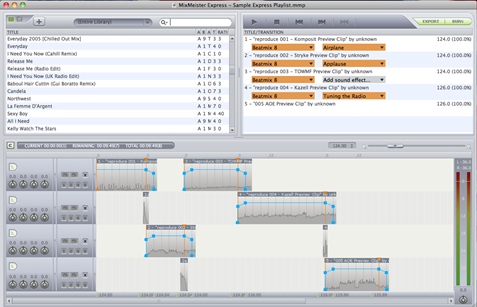
Express Screenshot

Populating the database is a breeze (and necessary for the program to determine beats per minute), and adding songs to your mix is as simple as clicking and dragging. (You can even go back and change the order of songs, something that was impossible in ye olden days.) There were several instances where the program would set up a mix to take place at the exact point that I would have chosen on my own, though if it doesn’t, changing the “anchor point” on both the outgoing and incoming song is a breeze. Most of the time, the only tweaking that needed to be done involved the volume settings – it tended to do kill the volume of the outgoing song a little early, and suddenly – but that was an easy thing to adjust. They’ve even come up with a couple flashy transition tricks: the ping pong cut (it jumps back and forth between songs on every half step) and the bass swap (exactly what you think it does). I tended not to use these in mixes, though, as they’re more distracting than a regular beat mix.

Looping was a little more difficult to grasp, which surprised me given my familiarity with Acid, where I had to create the loops manually before being able to use them. There are buttons on the left that are supposed to help you with this, but I found that using the short keys to mark the beginning and end of a loop was much cleaner. And stay on top of the looping, or it will get carried away; I looped the first four bars of Muse’s “Map of the Problematique,” and it just kept going on and on until I hit Stop. (I thought I had it set to loop only four times.) You’ll get very familiar with the Undo function, that’s for sure.

The most curious feature was the Smart Playlist, which will take a group of songs and automatically come up with transitions between them, based on your criteria. (You can create BPM caps, limit to a certain year, etc.) It’s a neat idea, but be prepared to massage the mixes some, rather than clicking Play sight unseen. I threw a handful of tracks together, and the results yielded several train wrecks.

As handy and as efficient as MixMeister Express is, I expect that the old-school DJs will declare it an abomination, since it renders them obsolete…and they have a point, sort of. There is a great quote in “The Incredibles” where weapons manufacturer-turned anti-superhero Syndrome tells his former idol Mr. Incredible that when everyone’s special, no one will be. This software does much the same thing, since it does the majority of the heavy lifting and eliminates much of the guesswork. But relax, fellow DJs: yes, this will enable people who can’t mix vinyl to make pretty good digital beat mixes, but no one is going to use MixMeister in a live scenario. This is purely a bedroom beat mix kind of program, and for someone like me who has two small kids and zero free time, that is exactly what I’m looking for.

MixMeister home page

« Older posts